City Unveils Plan for Center-Running Bus Lanes on Brooklyn's Flatbush Avenue
The Department of Transportation proposes replacing two car lanes with bus-only lanes and adding pedestrian islands on a congested stretch between Livingston Street and Grand Army Plaza.
By Jacob Leary ·
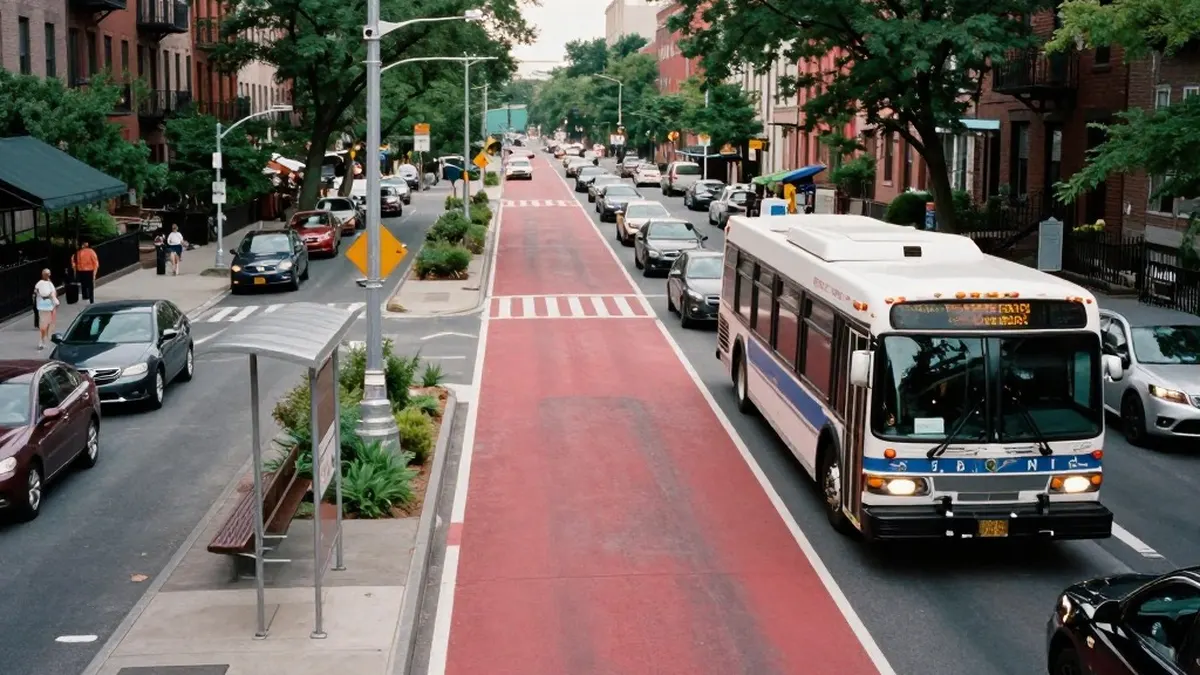
The city's Department of Transportation has unveiled a plan to overhaul a heavily congested section of Flatbush Avenue in Brooklyn, giving buses dedicated space in the middle of the roadway. The proposal was made public on Wednesday.
Under the design, two car lanes between Livingston Street and Grand Army Plaza would be converted into bus-only lanes running down the center of the avenue. Pedestrian islands equipped with benches and canopies would be built in the median, giving riders a place to wait for their buses. Officials said private vehicles would be barred from the bus lanes around the clock. Some curbside parking would also be removed, although DOT representatives did not say how many spaces would be affected.
The layout is the most ambitious of three redesign options the agency released last year. The department had earlier indicated that work could begin this summer, but on Wednesday officials declined to offer a timeline. They noted that the proposal will first go before Brooklyn Community Board 2 on Thursday.
The plan arrives amid criticism of Mayor Eric Adams' record on bus service in a city whose buses are the slowest in the nation. Transit advocates have faulted the administration for scaling back major street redesigns. Adams pledged to build 150 miles of new bus lanes during his first term, but the DOT has added only 27 miles since he took office at the start of 2022. This year, however, the mayor has made moves to shift course, including a promise to restrict most car traffic and create a dedicated busway on 34th Street in Manhattan.
Transportation Commissioner Ydanis Rodriguez said in a statement that the current situation serves no one. "Right now, Flatbush Avenue above Prospect Park doesn't work for anyone," he wrote, pointing to nearly 70,000 daily bus riders facing long waits, drivers stuck in traffic and pedestrians crossing clogged intersections. He said the proposal would address each problem and "create a world-class, welcoming corridor for everyone."
The DOT said the redesign would speed up the 12 bus routes that use the corridor. City data show that the B41, the busiest of them, averages just 4 mph during peak hours. The agency also said the changes would improve safety, citing 55 people killed or severely injured in crashes along the stretch since 2019.
Danny Pearlstein, spokesperson for the advocacy group Riders Alliance, welcomed the proposal. "For decades, the city has been looking for better service, and now, finally, this proposal is near reality," he said, adding that the DOT was "picking its most robust bus lane treatment ever."
The department is still developing plans to extend bus lanes along the full length of Flatbush Avenue to Kings Plaza. City officials are also weighing several proposals for a broader redesign of the streets around Grand Army Plaza that would make the area friendlier to pedestrians.
According to the DOT, 60% of people who live on or near Flatbush Avenue do not own a car and depend on slow bus service. The agency added that the buses on the street primarily serve low-income and Black New Yorkers.
Originally published by News Media House · Source: Gothamist